The signal tower project has pretty much come to an end. I’m going to defer the Clever Models crossing tower until I can figure out a better way to cut out the finer components, and whether I should change up my methods to include a “wrap” format over a blank matt board skeleton. Now I’ve got a few other things to work on, one being an order of ships that arrived this past week that need to be detailed, painted, and based. Plus, I still need to clear the last bit of superfluous stuff off the layout so we can get that completely back into operation.
There wasn’t much I managed to save from The Old Man’s final layout when we tore it down before selling the house and moving my stepmother to a smaller place. A few pairs of prewar Lionel manual turnouts, a bit of tubular track, and a handful of structures (most of which he’d scratch-built from scaled-up plans taken from various prewar and postwar magazines and books) accounts for most of it. I kept one of the trains, gave the Consoli Zephyr set to my daughter, while the rest, mostly postwar stuff, was sent off to relatives. I presume nearly all of that has been dispositioned at yard sales or trashed. My brother took all of the HO gear, most of it being Mantua kits The Old Man had built during the 1950s. I suspect that’s still packed away somewhere.
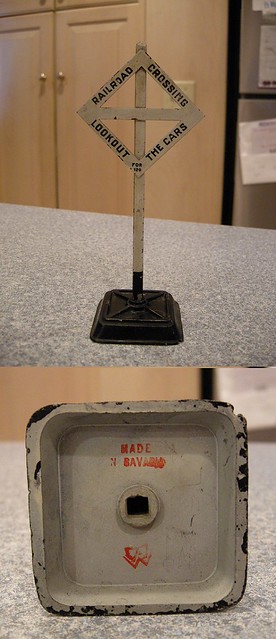
One of the things that I did save was a Plasticville switch tower that I had goaded him into buying/using on his pike. I recall this being contentious, as he abhorred anything made of plastic. Wood, cardstock, and metal were his raw materials of choice, and he stood by them as superior in the making of models. After a few rounds of argument, he finally agreed that if I could make a decent job of assembly, paint, and detail, he would find a spot for it. When I started this switch/signal tower project, I dug the old PV tower out, cleaned it up a bit, then re-cemented the acetate glazing into the windows. The few bits of ballast that still adhere to the base I left, and there's a sliver of Masonite that still clings to the underside:

Originally I had included shades in the windows, but only the one remains. Maybe someday I’ll find some yellowed paper and replace them. There was also something glued on the “platform”; what it was I don’t recall. I left the mark thinking maybe I’ll find it someday and replace it. Anyway, the forty year-old paint job has held up fairly well (but a lot could be done now to make it better).
Now, his father, my grandfather, was a first-gen German-American. At Christmas time, he would set up a “putz” on a small four-foot-square table/platform with a four-foot artificial tree in the center. It was a pretty involved process as I recall, the biggest task being to dye-n-dry a couple of pounds of sawdust green (used as grass to cover the platform). He had a few boxes of hollow cast tin figures and penny-toys he used to populate it, and the houses/buildings were similar to the small glittered cardboard ones found in sets in the dime-store. A few bottle-brush type “trees”, then a loop of two-rail track with a clockwork train of unknown manufacture, rounded out the set-up. I remember this thing going up every year until I was seven or eight years old; then he stopped doing it.
Now, I say the small houses were similar to but somewhat unlike the ones available commercially, as these were more ornate, almost architectural models of homes built during the 1930s around Baltimore. Later, I found out this was because The Old Man and his brother, my uncle, built and decorated most of them in order to save my grandfather a few bucks along the way (he was a legend in his sense of frugality). Somehow they were illuminated, and I can remember the whole thing being pretty spectacular at night with the tree and little houses lit and the room lights off.
The reason I mention all this is that one item on the bucket list is to take an eventual shot at replicating some of this personal nostalgia, as best I can remember it. I’ve acquired two or three clockwork trains and some hollow cast civilian figures, and I’ve accumulated a few store-bought cardboard glitter-houses, although they are nowhere near as cool as the ones my grandfather had (thanks to his sons). So I’ve been kicking around the idea of making a few. My friend Howard Lamey’s been helping me with ideas, and I decided I’d build a switch/signal tower as my first attempt (look away if you’re squeamish):
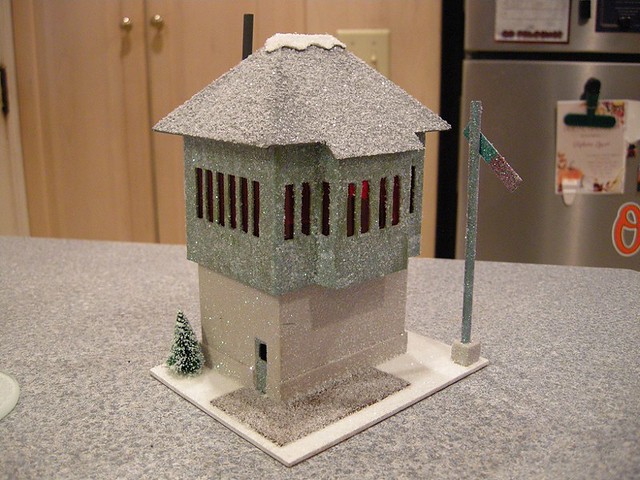
I used a photo of the tower that once stood at the junction of the old Union Railroad in Baltimore near the intersection of Biddle Street and Guilford Avenue. I think it would have been better if I’d used one that had windows in the lower level (this one, I think the whole lower level was of poured concrete). I made a few other mistakes, one being that I used rather dull colors and, two, I went a bit too heavy on the glitter. Anyway, first attempt so you learn from the mistakes. I might try this again, or move on to a small station.
Speaking of which, I still have this model of a suburban station The Old Man left behind:

I kept it for any of a number of reasons, one being his extensive use of bits of course sandpaper to simulate a stucco exterior. Maybe I'll finish this someday.