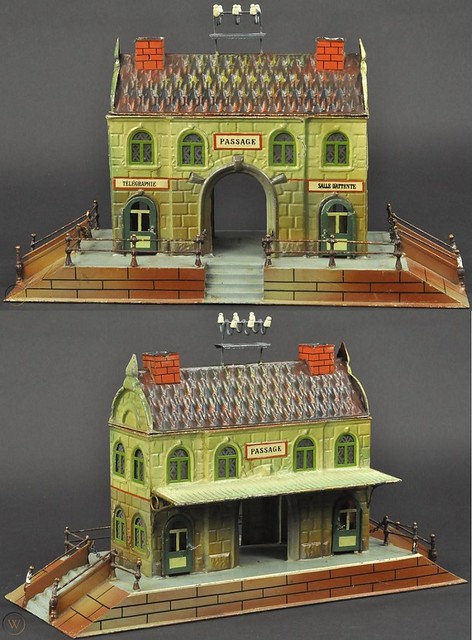
Thanks, Hondo. From a distance, you might not recognize it as not being embossed tin, but a close inspection would give it up pretty quickly. The biggest problem in using corrugated for this project, or any project, is how to handle exposed edges. I tried a number of things in an effort to fill them, ranging from green putty, spackling, or simply thick paint, but none of those had a good effect. One has to engineer it such that a minimum of exposed edges are presented.
The two-rail track is Marklin. It's made for clockwork trains. Sarge had a pile of it which he had me sell for him at York. When I decided I wanted a few examples of mechanical trains, I reached out to the guy I sold it to to see if he still had it, which he did, and I was able to get it back from him. It was two pieces short of a complete circle, so I had to run down a couple curves. After a few months, I found a guy in the Netherlands that had Marklin track that was willing to sell me just a couple of pieces. Marklin track is pretty neat in that it has built-in track clips that hold the sections together:

The locomotive poking out from the back of the station is a postwar version of the Hornby 101 tank engine. I don't know too much about these things, but I've seen quite a few of these over the years, so they must not be uncommon. These were originally manufactured before WWII, and I believe they were offered in a number of road names (although LMS seems the most common).
I picked up this set, including the 101, a few months back from Ray Ellen of Vienna Station:

I was looking for an example of Hornby and this small set popped up on Ray's list. It cost me a hundred bucks, but I think it was worth it. One coach has a small crease in the side that could likely be pulled out, but I'm going to leave it alone. I've got other more pressing projects requiring unbending tabs

I lettered the station for the depot at Tebay, a stop on the old London & North Western Railway and an affiliate of the LMS. The history of railroading in the UK is pretty interesting, and you find that a lot of the innovation we like to think as having been American actually originated in Britain.