Chuck, that is amazing!
Dan Weinhold
Whatzit?

Re: Whatzit?
chuck wrote:Desert Willow, aka Chilopsis linearis
You got it Chuck. Fascinating that plants from two very different families should have flower designs so similar. I wonder if the vine flower is pollinated by giant bees.

Photo of another of the very friendly giant bees.

----Wayne----
Back when I was growing up, if you didn't start someth'n, there wouldn't be noth'n.
--Merle Haggard
Back when I was growing up, if you didn't start someth'n, there wouldn't be noth'n.
--Merle Haggard
-
Rufus T. Firefly

- Posts: 42219
- Joined: Wed May 16, 2007 7:52 am
- Location: To be Determined
Re: Whatzit?
webenda wrote:Fascinating that plants from two very different families should have flower designs so similar. I wonder if the vine flower is pollinated by giant bees.
Probably something similar to promote pollination......
What if lollipops moaned every time we licked them?
Re: Whatzit?
chuck wrote:Check this out. Nothing to do directly with Whatzit but it is incredibly cool and is related in terms of image capture/display
Well, as long as we are going to thread drift, I can have some fun with this one.
First, not impressed. I do the same thing with photos from my cell phone camera.


----Wayne----
Back when I was growing up, if you didn't start someth'n, there wouldn't be noth'n.
--Merle Haggard
Back when I was growing up, if you didn't start someth'n, there wouldn't be noth'n.
--Merle Haggard

Re: Whatzit?
Yeah, but they did that for a painting that is near life size in terms of the subject matter (~12'x14').
It's a 44.8 Gigapixel image that consists of 528 individual photos that were digitally stitched together. I've been zooming over the painting at various levels of magnification and I can't find any stitch marks and certainly nothing like the google 360 image of the train tracks. I'm sure they used motion control camera to scan it in and probably a moving light source to make the illumination even. What is even more impressive to me is how the artist was able to generate such small details with significantly lower levels of technology.
It's a 44.8 Gigapixel image that consists of 528 individual photos that were digitally stitched together. I've been zooming over the painting at various levels of magnification and I can't find any stitch marks and certainly nothing like the google 360 image of the train tracks. I'm sure they used motion control camera to scan it in and probably a moving light source to make the illumination even. What is even more impressive to me is how the artist was able to generate such small details with significantly lower levels of technology.
Once I built a railroad, I made it run,
Made it race against time.
Once I built a railroad, now it's done --
Brother, can you spare a dime?
Made it race against time.
Once I built a railroad, now it's done --
Brother, can you spare a dime?
Re: Whatzit?
The picture from The Rijksmuseum in Amsterdam has 44.8 gigapixels (44,804,687,500 pixels.)
What kind of camera takes images that big? Maybe none but that is not how they did it. They used a 50 megapixel camera, like the Fuji GFX 100 and stitched togetheer 528 exposures divided into 24 rows of 22 pictures to make the big image.
Nothing new about stitching. One day I was putting gas into my truck when a rainbow appeared in the eastern sky just as the sun sat in the west. My cell phone does not have a wide enough lens to photograph a whole rainbow, so I took a bunch of photos along the expanse of the rainbow and stitched them together to get one image of the rainbow. The Samsung Galaxy S7 edge has a 12 megapixel camera so 5 images might produce a 60 megapixel image. 528 would make a 6.3 gigapixel image. We are getting there. Only 3,734 cellphone pictures to beat what the Rijksmuseum did.
----Wayne----
Back when I was growing up, if you didn't start someth'n, there wouldn't be noth'n.
--Merle Haggard
Back when I was growing up, if you didn't start someth'n, there wouldn't be noth'n.
--Merle Haggard
Re: Whatzit?
I've been trying to stitch photographs together since my third year as an undergraduate, mainly with arial photo's to make "mosaics" for mapping purposes. It's very hard to do with 3d real world objects, especially when the airplane taking the pictures is bouncing around and the ground isn't flat/level. We would get it as close as possible and then fudge it with pencils, white/gray paint (most of the photo's were B&W.
When I got my first SLR it would sometimes try to make up mosaics first with the 50mm, then a 28mm and finally with a 20mm. Even with a tripod and careful overlap it was very difficult. Horizon lines would subtly shift, lighting would change, clouds moved, etc. My fist digital camera had a stitch function and that was better than the old school method but still wasn't perfect. Second generation digital is better but still not quite there. Closest I got was a panorama I used for a Christmas letter about 12 years ago. It was a series of shots taken at the Getty with the family. We were looking at the gardens below the main museum and I had to run the images on a diagonal to limit the distortion at the match lines. This did introduce a different kind of distortion but the angles of the building and short focal length helped disguise it.

I have a second set of images of a redwood from Muir Woods that I try to stitch together. Doesn't go well at least as far as I am concerned. There wasn't enough room to get back to shoot the three images with the correct amount of overlap. I can get 1 and 2 or 2 and 3 but never all three. When I get bored with other stuff I pull up the photo's and try again.
When I got my first SLR it would sometimes try to make up mosaics first with the 50mm, then a 28mm and finally with a 20mm. Even with a tripod and careful overlap it was very difficult. Horizon lines would subtly shift, lighting would change, clouds moved, etc. My fist digital camera had a stitch function and that was better than the old school method but still wasn't perfect. Second generation digital is better but still not quite there. Closest I got was a panorama I used for a Christmas letter about 12 years ago. It was a series of shots taken at the Getty with the family. We were looking at the gardens below the main museum and I had to run the images on a diagonal to limit the distortion at the match lines. This did introduce a different kind of distortion but the angles of the building and short focal length helped disguise it.
I have a second set of images of a redwood from Muir Woods that I try to stitch together. Doesn't go well at least as far as I am concerned. There wasn't enough room to get back to shoot the three images with the correct amount of overlap. I can get 1 and 2 or 2 and 3 but never all three. When I get bored with other stuff I pull up the photo's and try again.
Once I built a railroad, I made it run,
Made it race against time.
Once I built a railroad, now it's done --
Brother, can you spare a dime?
Made it race against time.
Once I built a railroad, now it's done --
Brother, can you spare a dime?
Re: Whatzit?
The rainbow was done in-camera. It is amazing what they put in digital cameras now-a-days.
----Wayne----
Back when I was growing up, if you didn't start someth'n, there wouldn't be noth'n.
--Merle Haggard
Back when I was growing up, if you didn't start someth'n, there wouldn't be noth'n.
--Merle Haggard
Re: Whatzit?
Yes, they can. New camera is both amazing and disappointing at the same time. It seems to add "warping" to the mix. If you know where to look, the "match" lines are actually pretty obvious. I had to take some pictures for a real estate agent regarding the sale of my father-in-laws house. It's a big old ranch with a family room and true two car garage off the front of one side. It was impossible to get the whole house in even with the widest setting or my 20mm rectilinear lens on my old SLR. New camera uses a "movie" like function to capture images and then stitches those together to get the panoramic view. I can tell where things get strange as the garage roof line starts running down hill.
Once I built a railroad, I made it run,
Made it race against time.
Once I built a railroad, now it's done --
Brother, can you spare a dime?
Made it race against time.
Once I built a railroad, now it's done --
Brother, can you spare a dime?
Re: Whatzit?
I see that my last post on May 16 has disappeared during our 10 minute break. I'll see if I can remember my ramblings on panorama stitching and repost.
----Wayne----
Back when I was growing up, if you didn't start someth'n, there wouldn't be noth'n.
--Merle Haggard
Back when I was growing up, if you didn't start someth'n, there wouldn't be noth'n.
--Merle Haggard
Re: Whatzit?
chuck wrote:When I got my first SLR it would sometimes try to make up mosaics first with the 50mm, then a 28mm and finally with a 20mm. Even with a tripod and careful overlap it was very difficult. Horizon lines would subtly shift, lighting would change, clouds moved, etc.
Same here. Got home from the Camera Store with my three panorama enlargements, cut the outside two about in the center where the middle picture ended and... only one point could be lined up. I didn't know a 28 mm lens was not 28 mm anywhere except in the center of the photograph.

So, back home with my second set of prints, I cut all three photos where most of the detail would line up. Better but still not perfect.
If you look inside an antique panorama camera you well see how it works. In this one as the camera rotates the film is moved past a narrow slit. The result is a the photo from beginning to end was taken at the primary focal length of the lens.

To accomplish this with an ordinary camera would require thousands of photos all cut and stitched out of the center portion only.
----Wayne----
Back when I was growing up, if you didn't start someth'n, there wouldn't be noth'n.
--Merle Haggard
Back when I was growing up, if you didn't start someth'n, there wouldn't be noth'n.
--Merle Haggard

Re: Whatzit?
[quote="webenda"]I see that my last post on May 16 has disappeared during our 10 minute break.
Mine also. Not a big deal.
Mine also. Not a big deal.
Last edited by rogruth on Tue May 19, 2020 6:52 pm, edited 1 time in total.
roger
I support thread drift.
If God didn't want women to be looked at, He would have made 'em ugly. RAH
I support thread drift.
If God didn't want women to be looked at, He would have made 'em ugly. RAH
Re: Whatzit?
chuck wrote:I can tell where things get strange as the garage roof line starts running down hill.
A couple of causes for this.
Parallax Error. This is a problem where close objects seem to change position between frames because the camera has changed position, due to not being rotated around the 'no parallax point' of the lens (also variously referred to as the entry pupil or nodal point of the lens). If you hold the camera out in front of you and rotate your body you will get this. To eliminate parallax walk around the camera so that the lens is rotating about its center or mount the camera offset on the tripod so that the center of the lens rotates about the tripod's rotation axis.
Angle of view. The apparent roof angle depends on the angle of view of the camera. The solution is to have enough image overlap to chose a different stitch point that allows the whole roof to be included between stitch points.

In the upper photo, you see two distortions, the roof line is at the wrong angle because the camera was aimed at an angle to the house and the stitch point is in the center of one photo and on the edge of the other. You can clearly see that the lens focal length is different at the edge of an image than in the center.
In both photos but even more pronounced in the lower panorama, you can see that the camera AUTO EXPOSURE used a different setting for each of the stitched photos. The solution for this is to set the camera on MANUAL EXPOSURE.
Last edited by webenda on Tue May 19, 2020 5:12 pm, edited 1 time in total.
----Wayne----
Back when I was growing up, if you didn't start someth'n, there wouldn't be noth'n.
--Merle Haggard
Back when I was growing up, if you didn't start someth'n, there wouldn't be noth'n.
--Merle Haggard
Re: Whatzit?
When exposing a panorama photo, besides keeping the camera exposure setting constant, the camera must be kept parallel to the plane of the earth (or aimed so the horizon is at the center of the image.) If the camera is aimed up, the horizon will be concave. If the camera is aimed down, the horizon will be convex. If you change the angle of the camera during panning, the horizon will be curved up or down from the point of camera angle change. Is that what happened in the left side of your example panorama or is the landscaping tilted up?
Some panorama distortions can be corrected after stitching. I played with your image a little bit, trying to push the concave horizon line up to a straight line. My software (Corel Paintshop) did not have enough power to bend it all the way straight. I think Adobe Photoshop can do it.
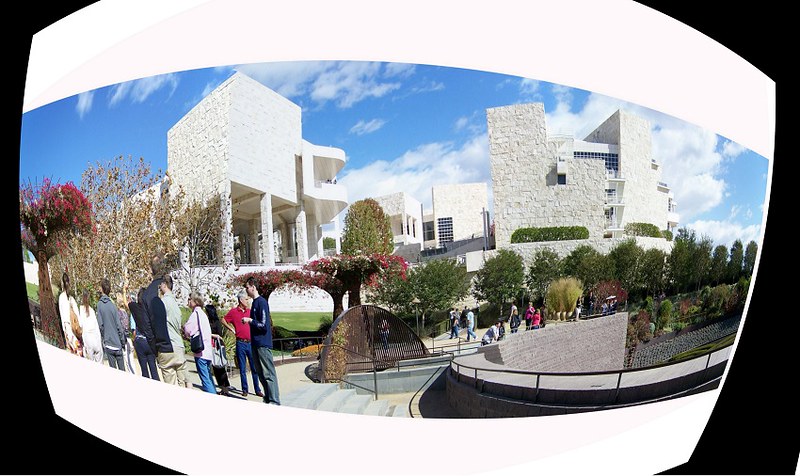
Some panorama distortions can be corrected after stitching. I played with your image a little bit, trying to push the concave horizon line up to a straight line. My software (Corel Paintshop) did not have enough power to bend it all the way straight. I think Adobe Photoshop can do it.
Last edited by webenda on Tue May 19, 2020 5:02 pm, edited 1 time in total.
----Wayne----
Back when I was growing up, if you didn't start someth'n, there wouldn't be noth'n.
--Merle Haggard
Back when I was growing up, if you didn't start someth'n, there wouldn't be noth'n.
--Merle Haggard
-
MurphOnMillerAve

- Posts: 18489
- Joined: Fri Jul 18, 2008 10:18 pm
- Location: Kennywood Park
- Contact:
Re: Whatzit?
The house and yard sure look like they've been well-groomed and tidied up quite a bit.
Return to “The Club Car Lounge”
Who is online
Users browsing this forum: No registered users and 106 guests