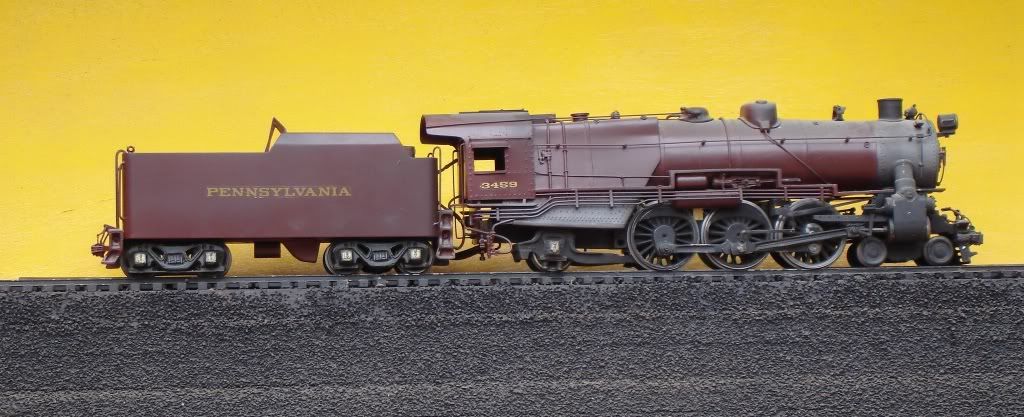
Joe here is a picture of it
Allan
K4
Re: K4
Allan,
As I thought, the flanges on the front and rear drivers appear to be larger than they have to be. How much existing space is there between the flanges on the front and rear drivers and the center driver tires? I cannot tell from your angled photo. What is the driver diameter as it is now? Assuming you have a good metal lathe, the modification to add flanges to the main drivers is a very doable project. How much lateral motion play is in the front and rear drivers? If the mechanism it too tight you may have to rework the front and rear driver/axles to allow for some lateral motion once the main drivers are flanged.
If the model runs nicely now it may not be worth the time you will spend on this project.
Best regards,
Joe
As I thought, the flanges on the front and rear drivers appear to be larger than they have to be. How much existing space is there between the flanges on the front and rear drivers and the center driver tires? I cannot tell from your angled photo. What is the driver diameter as it is now? Assuming you have a good metal lathe, the modification to add flanges to the main drivers is a very doable project. How much lateral motion play is in the front and rear drivers? If the mechanism it too tight you may have to rework the front and rear driver/axles to allow for some lateral motion once the main drivers are flanged.
If the model runs nicely now it may not be worth the time you will spend on this project.
Best regards,
Joe
Joe Foehrkolb
-
bob turner
- Posts: 13646
- Joined: Sat Jan 13, 2007 7:57 pm
Re: K4
Here is a shot of the rear driver geared Scale Craft with flanges:
I have done all three types of K4 frames this way - never a problem with clearance. Most require quartering in the frame, since they are just drilled. But some are split, so you can quarter and then reinstall. For me, it is worth it.
Even though PRR used a lot of blind flanges, our oversize flanges accentuate the look. All of my PRR steam gets full flanges.

I have done all three types of K4 frames this way - never a problem with clearance. Most require quartering in the frame, since they are just drilled. But some are split, so you can quarter and then reinstall. For me, it is worth it.
Even though PRR used a lot of blind flanges, our oversize flanges accentuate the look. All of my PRR steam gets full flanges.
Re: K4
Bob, nice job!
Joe, I see what you are saying and all that is doable, keep some lateral play and drivers do have more flange than needed, they are the regular 78" Scalecraft stock drivers, I think with .060" flanges. I did quite a bit of work on this engine when I rebuilt it. Complete tear down and resoldered everything. Not the stock tender, Bob gave me a nice small rivets wrapper and I made it with a cast frame and correct height on the deck. Seeing Bob's engine the flanged center driver looks much better. I did this when I was in the outside third rail period so it still has uninsulated wheels.
The work to take it all down and fix everything and put it back together does not bother me. It does have the non split frame but I made a quartering fixture that works on these.
I do have a good metal lathe but don't have the skill to do driver insulating. More later
Allan
Joe, I see what you are saying and all that is doable, keep some lateral play and drivers do have more flange than needed, they are the regular 78" Scalecraft stock drivers, I think with .060" flanges. I did quite a bit of work on this engine when I rebuilt it. Complete tear down and resoldered everything. Not the stock tender, Bob gave me a nice small rivets wrapper and I made it with a cast frame and correct height on the deck. Seeing Bob's engine the flanged center driver looks much better. I did this when I was in the outside third rail period so it still has uninsulated wheels.
The work to take it all down and fix everything and put it back together does not bother me. It does have the non split frame but I made a quartering fixture that works on these.
I do have a good metal lathe but don't have the skill to do driver insulating. More later
Allan
-
bob turner
- Posts: 13646
- Joined: Sat Jan 13, 2007 7:57 pm
Re: K4
Yeah, you do. The secret is finding the right tube for the tires. My brother used Leadloy, but I could never see wasting all that steel, and found iron pipe of appropriate diameters.
Machine the tire on the end of the tube, cut the inner wall of the tube to an appropriate diameter, and then just cut the tire from the tube. If your cutoff tool is like mine, you may need a hacksaw. All six can have the same inner diameter. Or, you can mix and match, saving three of the drivers with flanges for one side - depends on the counterweights.
If you do not have collets, you need an arbor. Machine one for a very light press-fit, be careful to mark it so it can go in and out of the three-jaw always at the same angle, and thread the end so you can put a nut on it and really hold that driver.
The ones that get insulated need to have more material taken off - this is kind of trial and error. Joe uses fish paper, and probably has it down to a science. I just use various thicknesses of ordinary card stock, and soak it with Loctite shaft on assembly.
Once the tires are pressed and the Loctite has set, you can make very fine cuts with a sharp tool to make sure each driver is good looking and concentric, without wobble. Then use a file and some sand paper to polish it up. Do not overheat the Loctite.
Or, strip to the drivers and send to Joe - he does this stuff in his sleep, and his prices are more than reasonable.
Machine the tire on the end of the tube, cut the inner wall of the tube to an appropriate diameter, and then just cut the tire from the tube. If your cutoff tool is like mine, you may need a hacksaw. All six can have the same inner diameter. Or, you can mix and match, saving three of the drivers with flanges for one side - depends on the counterweights.
If you do not have collets, you need an arbor. Machine one for a very light press-fit, be careful to mark it so it can go in and out of the three-jaw always at the same angle, and thread the end so you can put a nut on it and really hold that driver.
The ones that get insulated need to have more material taken off - this is kind of trial and error. Joe uses fish paper, and probably has it down to a science. I just use various thicknesses of ordinary card stock, and soak it with Loctite shaft on assembly.
Once the tires are pressed and the Loctite has set, you can make very fine cuts with a sharp tool to make sure each driver is good looking and concentric, without wobble. Then use a file and some sand paper to polish it up. Do not overheat the Loctite.
Or, strip to the drivers and send to Joe - he does this stuff in his sleep, and his prices are more than reasonable.
-
John Webster

- Posts: 839
- Joined: Sat Feb 05, 2011 4:29 am
- Location: Painesville, Ohio
Re: K4
There might be some usable tires here:


You begin flying with a full bag of luck and an empty bag for experience. The object is to fill the bag of experience before you empty the bag of luck.
Re: K4
Is the intent to keep the original paint job on the OP model? If so, why bother flanging the main drivers? PRR BUILT THEM THAT WAY! In later years, when the locos needed shopping, PRR policy changed & all drivers received flanges, but if you study photos I don't think you'll find that fancy tender striping on fully-flanged locos.
The Scale-Craft K4 models and many of the early K4 imports followed prototype practice and had blind main drivers. If you are modeling a post-1940 appearance, full flanges I think would be more correct, but not with fancy striping on a conventional-style tender. (The various streamlined K4s did get tender stripes when modified.)
In the early days of scale models, blind main drivers were supplied on many locos, even though that was inaccurate for many prototypes, in order to get around unrealistic model RR curves. An "unrealistic" curve for models of large road steam locos is anything smaller than 6' RADIUS (not diameter), because 6' radius is the scale equivalent of a prototype 20-degree curve. That is the minimum curve for most large steam locos (some required even larger radii) and would be negotiated at a crawl to avoid derailing.
For those interested, try to find a speed limit table for various prototype curve radii. The laws of physics favor models over prototype, in that we can operate our "little" trains at far higher speeds over proportionally unrealistic sharp curves than the prototype could handle. A model K4 on a 5' radius curve is not realistic because the prototype could never run on a curve that sharp in the first place! But that fact does not stop us from running our trains even on 4' radius curves if we desire.
Even when a railroad had all flanged drivers on six- & eight-coupled locos, many ten-drivered locos were built with and retained blind main drivers. Also blind intermediate drivers were common on logging locos with six or eight drivers because of very tight curves.
The Scale-Craft K4 models and many of the early K4 imports followed prototype practice and had blind main drivers. If you are modeling a post-1940 appearance, full flanges I think would be more correct, but not with fancy striping on a conventional-style tender. (The various streamlined K4s did get tender stripes when modified.)
In the early days of scale models, blind main drivers were supplied on many locos, even though that was inaccurate for many prototypes, in order to get around unrealistic model RR curves. An "unrealistic" curve for models of large road steam locos is anything smaller than 6' RADIUS (not diameter), because 6' radius is the scale equivalent of a prototype 20-degree curve. That is the minimum curve for most large steam locos (some required even larger radii) and would be negotiated at a crawl to avoid derailing.
For those interested, try to find a speed limit table for various prototype curve radii. The laws of physics favor models over prototype, in that we can operate our "little" trains at far higher speeds over proportionally unrealistic sharp curves than the prototype could handle. A model K4 on a 5' radius curve is not realistic because the prototype could never run on a curve that sharp in the first place! But that fact does not stop us from running our trains even on 4' radius curves if we desire.
Even when a railroad had all flanged drivers on six- & eight-coupled locos, many ten-drivered locos were built with and retained blind main drivers. Also blind intermediate drivers were common on logging locos with six or eight drivers because of very tight curves.
woody
-
bob turner
- Posts: 13646
- Joined: Sat Jan 13, 2007 7:57 pm
Re: K4
Woody loves it when a wheel is off the track. But here is another - Scale Craft boiler, which obviously fell victim to some wife or another in the distant past, hammered into a useless set of dents. I restored it, added an Alexander frame of some disrepute, and a Max tender.

On the blind flanges - real railroads have such small flanges you really have to look. Not so O Scale models - our flanges are giant, making missing flanges look horrible. Opinion. Horrible. Opinion.

On the blind flanges - real railroads have such small flanges you really have to look. Not so O Scale models - our flanges are giant, making missing flanges look horrible. Opinion. Horrible. Opinion.
-
Rufus T. Firefly

- Posts: 42161
- Joined: Wed May 16, 2007 7:52 am
- Location: To be Determined
Re: K4
jwmathews wrote:Is the intent to keep the original paint job on the OP model? If so, why bother flanging the main drivers? PRR BUILT THEM THAT WAY! In later years, when the locos needed shopping, PRR policy changed & all drivers received flanges, but if you study photos I don't think you'll find that fancy tender striping on fully-flanged locos.
Might be interesting to do a little leg-work and dig up a few prototype photos of that era and finish/build to a specific loco......or sell it to someone that might want the earlier incarnation of a specific K4.
If you only read the books that everyone else is reading, you can only think what everyone else is thinking.
Re: K4
Allan,
I will be starting on the reworking of your Scalecraft K-4 drivers tomorrow, August 13th. The existing drivers measure close to 0.2" in width across the tires. That is considerably wider than even the old NMRA standards of 0.172". At this time, I am not sure I can get the main driver axle out of the frame. The drivers are all off of their axles. The worm gear and shaft needs to be removed to access some sort of fastener that attaches the worm gear to the main driver axle. We will see where this goes. If I can get the main driver axle out, I can machine all of the drivers to a finer standard while l I am doing this job. All axles would be shortened and center drilled in the process.
You did not include a note with your loco frame. Your direct email would be helpful for communication.
Joe Foehrkolb
I will be starting on the reworking of your Scalecraft K-4 drivers tomorrow, August 13th. The existing drivers measure close to 0.2" in width across the tires. That is considerably wider than even the old NMRA standards of 0.172". At this time, I am not sure I can get the main driver axle out of the frame. The drivers are all off of their axles. The worm gear and shaft needs to be removed to access some sort of fastener that attaches the worm gear to the main driver axle. We will see where this goes. If I can get the main driver axle out, I can machine all of the drivers to a finer standard while l I am doing this job. All axles would be shortened and center drilled in the process.
You did not include a note with your loco frame. Your direct email would be helpful for communication.
Joe Foehrkolb
Joe Foehrkolb
Re: K4
OK here it is, back from Joe. Two railed and drivers/crankpins narrowed for more accurate appearance. Gives more clearance for the valve gear too (helps hide our O scale original sin, five foot gauge). Pretty nice huh? I think so.
Allan
Oh Yes, the blind center driver is correct for a K4 painted like this one. Woody said so and I looked it up. Later they went to all flanges but this engine represents #5400 in early years.
Allan
Oh Yes, the blind center driver is correct for a K4 painted like this one. Woody said so and I looked it up. Later they went to all flanges but this engine represents #5400 in early years.
- Attachments
-
- IMG_1119.JPG (90.54 KiB) Viewed 10978 times
-
- IMG_1120.JPG (72.85 KiB) Viewed 10978 times
Re: K4
bob turner wrote:On the blind flanges - real railroads have such small flanges you really have to look. Not so O Scale models - our flanges are giant, making missing flanges look horrible. Opinion. Horrible. Opinion.
If the drivers are depicted as they were on the real thing, I am not offended by them being blind. I am guessing the weight of the real loco (as opposed to the weight of a model) has a lot to do with the size of the flanges. I have a couple of Hippos with the blind center driver (they were modified from 3 blinds to 1 in the real world). I suppose the change was because the 3 blinds made them (the prototype) too likely to derail????? Interesting stuff to ponder.
Rich
Re: K4
Bob
If you look at the picture earlier in this thread of the engine and tender you will see the wrapper you sent me on the scratchbilt tender. Didn't use the Scalecraft tender. Thought you would like to know I put it to good use. Thanks again.
Allan
If you look at the picture earlier in this thread of the engine and tender you will see the wrapper you sent me on the scratchbilt tender. Didn't use the Scalecraft tender. Thought you would like to know I put it to good use. Thanks again.
Allan
-
bob turner
- Posts: 13646
- Joined: Sat Jan 13, 2007 7:57 pm
Re: K4
Did not realize that. Wound up looking pretty good! Where did you get decals?
Return to “O-Gauge, 2-Rail, Model Railroading”
Who is online
Users browsing this forum: No registered users and 102 guests