Subway, Elevated, Trolley & Traction Lines photos

All City Subway Models & Elevated Lines
User avatar
healey36
Posts: 6938
Joined: Fri Sep 03, 2010 4:43 pm
Location: Westminster, MD

Re: Subway, Elevated, Trolley & Traction Lines photos

Postby healey36 » Sun Jan 14, 2018 10:23 am

Here's a shot of the elevated railway interlocking tower at Pulaski Road in Chicago, taken in 1968 as part of the survey done for HAER (Historic American Engineering Record):

Image

Is that the third-rail with the ten-foot gap in a left foreground? What's up with that?

Healey

Joseph Frank1
Posts: 794
Joined: Mon Mar 15, 2004 3:51 pm
Location: Southeast Pennsylvania
Contact:

Re: Subway, Elevated, Trolley & Traction Lines photos

Postby Joseph Frank1 » Sun Jan 14, 2018 12:58 pm

Healey --

Gaps in Third rails were common in subway and El's and other 3rd rail equipped electric railways and at times were at switches.

But mainly used where High-Voltage Control Multiple-Unit equipped EL & Subway train cars ran. The long break in the 3rd rail usually indicated the end of a "section break" -- long sections of trackage controlled and powered by a similar length of parallel 3rd rail.

It was isolated from the next "section break" of trackage -- and so on up and down the line. T his allowed sections of track and their 3rd rails to be "cut off' and isolated -- perhaps due to an accident, or work ongoing. Hi-Voltage trains had 600 Volt BUSS jumper cables between each of the cars -- to pass the control current circuits for MU trains from the first to the last car...including thru TRAILER cars which did NOT have 3rd rail shoes...thus getting their "juice" for lights and heaters, from the adjacent motor cars.

Strictly enforced signs AND SIGNALS (called section break signals) on the R-o-W's alerted motormen about section break locations...and a red indication lamp on a S/B signal meant STOP THERE at that signal (BEFORE the break). Because the in Hi-Voltage train, itself would become one long extension cord connecting both section break segments, and thus energizing the 3rd rail in the shut off section.

IRT Section Break signals.jpg
IRT Section Break signals.jpg (58.31 KiB) Viewed 22903 times


regards - Joe F

User avatar
healey36
Posts: 6938
Joined: Fri Sep 03, 2010 4:43 pm
Location: Westminster, MD

Re: Subway, Elevated, Trolley & Traction Lines photos

Postby healey36 » Mon Jan 15, 2018 10:48 am

Thanks for that, Joe...it brings some clarity into the complexity of operating such "electric" systems. Presume that today all of that is computer-driven and that an operator/driver has little input in operation (unless manually overridden). Here in the DC area we are witness to the complexity of the system and what happens when things are improperly dealt with or decision-making is poor.

Dumb question...when the train crosses these gaps is there a momentary loss of power, i.e. do the car lights momentarily dim/flickr? I see this occasionally on the DC and Baltimore Metro systems and have always wondered what causes that.

Here's a pic of the interior of the Pulaski tower from the same HAER survey:

Image

Interesting smoke-shroud over the stove, and some guy left his wrench leaning on the ladder on the right.

The steel I-beam looks like a late addition and it's unclear what the purpose is. Doesn't appear to be supporting the upper-floor.

Healey

Joseph Frank1
Posts: 794
Joined: Mon Mar 15, 2004 3:51 pm
Location: Southeast Pennsylvania
Contact:

Re: Subway, Elevated, Trolley & Traction Lines photos

Postby Joseph Frank1 » Mon Jan 15, 2018 11:50 am

Hello Healey

Most older Low-Voltage Control cars had 3rd rail shoes of ALL TRUCKS --- motor cars in the pre-war era had a MOTOR truck at one end and a Trailer Truck at the other -- except for the occasional fleets that had a Motor on ONE axle of EACH truck -- the companion wheelset in each truck being unpowered. ie; BMT Standard subway cars, Staten Island Rapid Transit ME-1 Cars, and IRT wooden Composite ex-subway EL cars.

Usually the MOTOR cars - whether 600 vold DC Buss jumper fed Hi-V Control motor cars, or Low-Voltage Motor Cars (no 6-0- volt buss jumpers between them) had 3rd rail shoes on BOTH sides of EACH truck. On the IRT, the Low-V Trailers had shoes on both side of only ONE truck. Hi-V Trailers had NO 3rd rail shoes. The same methods applied to Low-V and Hi-V Wooden Elevated Cars, at least on the IRT and BMT Elevated systems.

On Hi-V Cars train consists, there would be no flickering or outing of car lights over long crossovers or sections of missing 3rd rail....because the other cars in the train consist still in contact with the existing trackside 3rd rail would pass the 600 VDC current thru those 600 volt DC car-to car thick buss jumper cables.

On Low-Voltage Motor and Trailer cars --- on the IRT Systems EL and Subway lines - if the distance of any 3rd rail GAP was longer than the EL or Subway car length (between 48 to 51 feet or longer), the car crossing thru the gap would lose its 3rd rail current contact and its lights would go out, and on Motor cars the motors would also cut out for that short travel period also. Usually BATTERY OPERATED emergency lights would turn on during those very brief power gaps in 3rd rail.

Regards - Joe F

User avatar
robert.
Posts: 6008
Joined: Mon Mar 02, 2015 9:24 am

Re: Subway, Elevated, Trolley & Traction Lines photos

Postby robert. » Mon Jan 15, 2018 9:00 pm

Last week i took my daughter out for a train ride. During the ride i glanced out the window to see a wrench just like that one. If i did not have a 4 year old with me. may have walked 1.5 miles back from the station to grab it. Then i thought what would i do with it? give it to Murph to club a bear? Strange thing is i only wanted to see how heavy it is.
I spend entirely too many hours a day tying my shoes

User avatar
healey36
Posts: 6938
Joined: Fri Sep 03, 2010 4:43 pm
Location: Westminster, MD

Re: Subway, Elevated, Trolley & Traction Lines photos

Postby healey36 » Tue Jan 16, 2018 7:45 am

I've seen a number of wrenches similar to that at tool booths in local antique malls...might look impressive standing in the back-corner of the garage, but otherwise of not much use.

NYC 3rd Avenue El at 18th Street, Sept 1942:

Image

That's some significant weight on what looks to be rather spindly supports.

Healey

Edit :: Showing my age possibly, but what's this thing?:

Image

Police-box? Fire-box?

Tom Dempsey
Posts: 1002
Joined: Mon Dec 23, 2013 10:15 pm

Re: Subway, Elevated, Trolley & Traction Lines photos

Postby Tom Dempsey » Tue Jan 16, 2018 10:57 am

In case of drunkenness, break glass?

Joseph Frank1
Posts: 794
Joined: Mon Mar 15, 2004 3:51 pm
Location: Southeast Pennsylvania
Contact:

Re: Subway, Elevated, Trolley & Traction Lines photos

Postby Joseph Frank1 » Tue Jan 16, 2018 11:41 am

Hello

Thats an FDDNY Streetcorner Fire Alarm emergency public "call" box. You pulled the handle down and you could hear a low "hum" sound in the box as the circuit was sent to notify the nearest fire company station that a fire was at or adjacent to that streetcorner. They were all over the city in some vases mounted to lamp posts or wooden utility poles in outlying city areas

Here is a photo of one still remaining today

FDNY 1920's fire alarm corner box.jpg
FDNY 1920's fire alarm corner box.jpg (230.31 KiB) Viewed 22864 times


Here are two photos on my layout where I have these FDNY Alarm boxes which were shaped like a "house" and designed to be attached to street lights or wood utility poles. A Red Globe "box location" lamp was also mounted higher up for visibility on the streetlight post or utility pole

142_142_11033467906_o.jpg
142_142_11033467906_o.jpg (209.22 KiB) Viewed 22864 times
img_0011_15620103662_o.jpg
img_0011_15620103662_o.jpg (387.6 KiB) Viewed 22864 times


Regards - Joe F

User avatar
healey36
Posts: 6938
Joined: Fri Sep 03, 2010 4:43 pm
Location: Westminster, MD

Re: Subway, Elevated, Trolley & Traction Lines photos

Postby healey36 » Tue Jan 16, 2018 12:16 pm

Thanks for that Joe...does the globe-light illuminate when the alarm is pulled, or is it lit to indicate the location of the box if needed?

If I haven't said it before, your layout is outstanding. Seeing these photographs side-by-side with your layout shots is just exemplary.

Healey

Joseph Frank1
Posts: 794
Joined: Mon Mar 15, 2004 3:51 pm
Location: Southeast Pennsylvania
Contact:

Re: Subway, Elevated, Trolley & Traction Lines photos

Postby Joseph Frank1 » Tue Jan 16, 2018 6:12 pm

Hello Healey

Thanks for the compliments. I think B&W makes it look more "period realistic" because back in the 1950's & 60's most of us shot B&W -- tho I experimented with color slides in 1955 & '56 (VERY expensive then, heh) on the IRT 3rd Ave El ---came out great as it was.

By the early to mid 1960's I did more and more color (and color slide) work with the usual B&W prints of scenes (and transit in NYC) that i knew would be gone as I knew it in a few years (and it was, heh)

Check out these B&W images below -- along with the color one at the bottom - showing the steel ornamental bracket to hold the lamp housing and red globe on the wooden utility pole. The Red Globe was lit, came on, when the streetlight came on as I remember, on dark cloudy (stormy) days and at approaching evening.

img_0011_15620103662_o (2)-B&W.jpg
img_0011_15620103662_o (2)-B&W.jpg (352.65 KiB) Viewed 22857 times

164_164-dec2008_5488463600_o.jpg
164_164-dec2008_5488463600_o.jpg (105.21 KiB) Viewed 22857 times

2nd-story-window-view-to-tars-streetcar-in-shadows-of-the-el_5436940127_o.jpg
2nd-story-window-view-to-tars-streetcar-in-shadows-of-the-el_5436940127_o.jpg (147.45 KiB) Viewed 22857 times

051_51a_8349311614_o (2)-B&W.jpg
051_51a_8349311614_o (2)-B&W.jpg (311.95 KiB) Viewed 22857 times


regards - Joe F
Attachments
img_0009_15620103582_o.jpg
img_0009_15620103582_o.jpg (157.17 KiB) Viewed 22857 times

User avatar
Arthur P. Bloom
Posts: 754
Joined: Wed Dec 13, 2006 6:07 pm
Location: Eastern Long Island
Contact:

Re: Subway, Elevated, Trolley & Traction Lines photos

Postby Arthur P. Bloom » Tue Jan 16, 2018 10:11 pm

In the "too much information" department...

Those call boxes were connected in series, on one wire, that interconnected about 5 or 6 in a group. The assumption was that if there was a fire at a location anyone seeing it would pull the handle and others wouldn't, so the signals wouldn't get garbled. The signalling method is called a "McCulloch" circuit. Every box along the route had voltage running through it. A box, when pulled, sent a series of interruptions (opens) to the fire station. The fire station had many single wire routes radiating from it, along major avenues and streets.

A broken wire would be indicated as a trouble. The individual boxes sent specific series of codes which were decoded at the fire station into series of bell signals, which the firefighters would recognize as the nearest box address.

I recall that in the 1970's, the street lamp indicators were more of a reddish orange, not pure red. Leave it to our friend Joe and his amazing attention to detail to immortalize even these tiny relics of NYC street furniture.

http://forgotten-ny.com/1999/03/orange-alert-ancient-fire-alarms/

Scroll down for some info about the boxes and indicators.
"I'll have the roast duck...with the mango salsa."

Joseph Frank1
Posts: 794
Joined: Mon Mar 15, 2004 3:51 pm
Location: Southeast Pennsylvania
Contact:

Re: Subway, Elevated, Trolley & Traction Lines photos

Postby Joseph Frank1 » Wed Jan 17, 2018 12:48 am

Hello Arthur !

How have you been doing ? It's been a while !

Thanks for that very interesting description of the wiring and how the alarms worked and were sequenced ! Yes, you are correct --- there were mainly ORANGE globes for Fire Alarm Box lights -- later the globes replaced by those elongated orange glass (or plastic) tubular housings. But there were some red globes surviving --- I remember seeing them -- perhaps odd holdovers from the 1910's-20's ? Here are some photos -- but I just may repaint my 3 globes (for 3 boxes on 3 different lamp posts) to the orange color -- very easily done.

Fire alarm box.JPG
Fire alarm box.JPG (59.83 KiB) Viewed 22845 times

481999806.jpg
481999806.jpg (291.93 KiB) Viewed 22845 times


When modeling my El and subway trains, and then the EL structure and tracks, stations, for them to run in a realistic setting, I expanded the realism factor to include as much of the trackside street furniture and structures, and real estate building styles & variations, including the vintage landmark stores and signs of the (time of my youth) I very well remembered - to complement and complete the total layout trackside scenes. Sort of like a miniature Hollywood movie set ! And of course having the under-EL street traffic -- trolleys, buses, autos and trucks.

Obviously, "Elevated" trains look more natural and realistic running thru all that fine-detail trackside environment.

Regards - Joe F

User avatar
healey36
Posts: 6938
Joined: Fri Sep 03, 2010 4:43 pm
Location: Westminster, MD

Re: Subway, Elevated, Trolley & Traction Lines photos

Postby healey36 » Wed Jan 17, 2018 10:19 am

Was it standard practice to run trolley catenary beneath an elevated railway? Makes sense and it seems to be the case in most old photo's, but not all.

Here's another pic of the Bowery in 1898, this with trolleys running down the center:

Image

I don't see any overhead wires for the cars...third-rail at street level?

Joseph Frank1
Posts: 794
Joined: Mon Mar 15, 2004 3:51 pm
Location: Southeast Pennsylvania
Contact:

Re: Subway, Elevated, Trolley & Traction Lines photos

Postby Joseph Frank1 » Wed Jan 17, 2018 12:32 pm

Hello Healey

Yes, in all cases with streetcars (trolleys) using OVERHEAD WIRE for power collection while running under EL's, yes, the wire was strung under the EL's. Usually it (the wire) ran in a wooden channel shallow conduit which was anchored by steel brackets and beams to the underside El structure deckwork above. The trolley wire was attached with hangers to the center-underside of the top wooden plank of the channel.

On much higher EL Structures, like some in NY City, Boston (when they had EL's) and Chicago, the span wires to support the hangers and trolley wires, were anchored to the parallel EL Columns using insulators to insulate the span wire from the cable or bracket that attached the span wires to the El columns. There was no need for the protector channel in those specific circumstances.

The reason for the wooden "protector channels" under standard and low height El structures (and just similarly when going under steel railroad track overpass bridges) was to protect a de-wiring trolley pole from springing upward and slamming, clattering, against the underside of the bridge or EL structure steelwork, thus damaging or worse, breaking the pole. Also to protect a de-wired pole that possibly had its pole sliding against the SIDE of the "hot" trolley wire and thus having its 600 volt (positive) DC energized trolley shoe or harp "grounding" itself in some flashing pyrotechnics, against the grounded (negative) Elevated structure steel work.

City ordinances early in Manhattan when horsecars were to be replaced by "streetcars" demanded that NO TROLLEY WIRE BE USED over the streets. Early "horseless" Streetcars in Manhattan operated like San Francisco Cable Cars, by underground cables in a slot rail between the running rails. The other Boroughs of NYC were exempt from this rule as they were then very rural anyway.

That is what you see in early Bowery photos along the El there. As I notice NO THIRD RAILS yet on the EL structures, the streetcar was still running by underground slot-cable at that time...and the EL trains powered by Forney Steam Locos hauling the El trains. By the way, the pointed-roof bank building seen is still there. this view is looking northwest across the Bowery to the then 2 separate tracks of the EL over the sidewalks , just north of Grand Street and the original Grand Street two separate local stations on the EL. By 1914-15 an entirely newly built 3 track EL structure with twin-island-platform express stations - was built over the center of the Bowery - replacing the later closed and demolished original two separate lines and their stations.

Later by 1900 or so, the conduit for the cable was reorganized to have an INSULATED Positive rail and a negative rail side by side under the slot. A special Slot-shoe with contacts on each side made contact under the pavement with these power and return rails. The running rails were not involved electrically at all for any return ground circuit. this is the way Manhattan streetcars ran until their demise gradually, route by route, between 1930's and 1947. And between 1900 and 1903, all the 4 Manhattan El's were electrified.

regards - Joe F

User avatar
healey36
Posts: 6938
Joined: Fri Sep 03, 2010 4:43 pm
Location: Westminster, MD

Re: Subway, Elevated, Trolley & Traction Lines photos

Postby healey36 » Thu Jan 18, 2018 12:59 pm

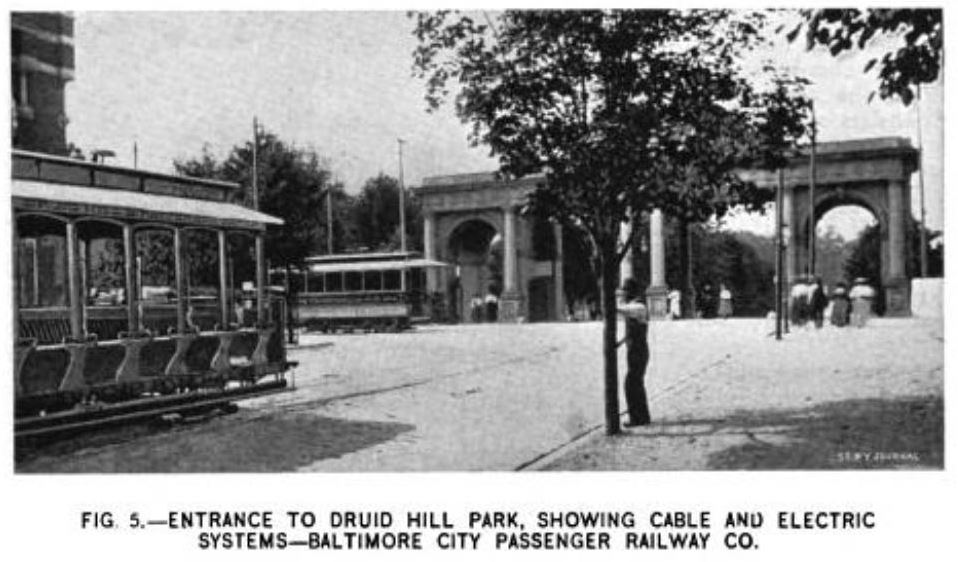
There was a cable-railway in Baltimore operated by the Baltimore Traction Company, running between Druid Hill Park and Patterson Park. It's tough to find any decent photo's of its operations. The power house at the northern end used to be at the corner of Druid Hill Avenue and Retreat Street but it burned down awhile back (most of that neighborhood looks like Berlin 1945 today). Besides housing the cable machinery there were two 500-HP Corliss engines in there...must have been something to see.

Here's a bit of history of the operation:

http://www.cable-car-guy.com/html/ccsrj_balt.html

http://www.cable-car-guy.com/html/ccdcbalt.html

Image


Return to “Subway, Elevated, Trolley & Traction Lines”

Who is online

Users browsing this forum: No registered users and 1 guest