
American Flyer misinformation

All Facets of O-Gauge, 3-Rail, Model Railroading
User avatar
Roy
Posts: 7849
Joined: Mon Aug 09, 2010 8:48 pm
Location: Lakewood, CA

Re: American Flyer misinformation

Postby Roy » Thu Jun 11, 2020 2:31 am

Robert Bubeck wrote:There is no cut off date to my knowledge for not painting the 21085's and 21107's.There are many variations of the 85's. Most all observed samples built and sold in the 1964-66 period are painted black over black plastic. Having unpainted unnumbered shells being passed around after the demise of Gilbert is another matter.

A little disclosure: over twenty five years ago, I worked at a train shop. I came across a bin containing three 21085 shells, which were apparently new, and unpainted. They looked legitimate enough, that I remembered them. Conceivably, they were unfinished moldings from Gilbert's closing that were later stamped. I don't know why anyone would bother to do that, on such a common, low-value item.

As I said before, I have a painted Milwaukee Road 21085. I also have a painted 1958 model, with the three-piece drivers. I notice whether an item is painted, or bare, molded-in-color plastic. I can't recall seeing complete 21085s that were unpainted.
Torturers, White Racists, Gay Bashers, Rich Psychopaths.

Robert Bubeck
Posts: 242
Joined: Mon Feb 14, 2011 4:04 pm
Location: Midland, MI
Contact:

Re: American Flyer misinformation

Postby Robert Bubeck » Thu Jun 11, 2020 12:40 pm

Roy wrote:
Robert Bubeck wrote:There is no cut off date to my knowledge for not painting the 21085's and 21107's.There are many variations of the 85's. Most all observed samples built and sold in the 1964-66 period are painted black over black plastic. Having unpainted unnumbered shells being passed around after the demise of Gilbert is another matter.

A little disclosure: over twenty five years ago, I worked at a train shop. I came across a bin containing three 21085 shells, which were apparently new, and unpainted. They looked legitimate enough, that I remembered them. Conceivably, they were unfinished moldings from Gilbert's closing that were later stamped. I don't know why anyone would bother to do that, on such a common, low-value item.

As I said before, I have a painted Milwaukee Road 21085. I also have a painted 1958 model, with the three-piece drivers. I notice whether an item is painted, or bare, molded-in-color plastic. I can't recall seeing complete 21085s that were unpainted.

As you have, I have never observed a completed 21085 that was not painted. As I am sure you also know, many unpainted shells of various descriptions were acquired by Amato during the dissolution of the Gilbert factory in 1967. So, there we are.

Bob

User avatar
Roy
Posts: 7849
Joined: Mon Aug 09, 2010 8:48 pm
Location: Lakewood, CA

Re: American Flyer misinformation

Postby Roy » Thu Jun 11, 2020 7:35 pm

Here's a website about All Aboard sets:

http://www.trainweb.org/allaboardsets/

It has a period commercial which clearly shows a painted 21085. This, of course, may have been from previous production.

I also enjoyed the photos of the 007 Road Race set:

http://www.trainweb.org/allaboardsets/bond.html
Torturers, White Racists, Gay Bashers, Rich Psychopaths.

User avatar
Roy
Posts: 7849
Joined: Mon Aug 09, 2010 8:48 pm
Location: Lakewood, CA

Re: American Flyer misinformation

Postby Roy » Mon Jun 15, 2020 3:44 pm

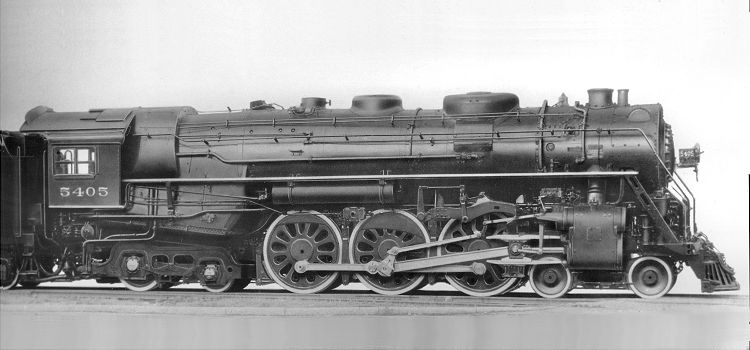
New York Central's J3a Hudson, which was the basis of American Flyer's 3/16 inch to the foot model:

Image

Image

The American Flyer model was introduced in 1939 in O gauge, and in 1946 in S gauge. The Gilbert HO Hudson model was based on the earlier New York Central J1 class.
Torturers, White Racists, Gay Bashers, Rich Psychopaths.

User avatar
Roy
Posts: 7849
Joined: Mon Aug 09, 2010 8:48 pm
Location: Lakewood, CA

Re: American Flyer misinformation

Postby Roy » Mon Jun 15, 2020 5:12 pm

Image

Full size photo: https://s3.amazonaws.com/marketplace.collector-modeltrains.com/f575a9f7c8282681a952b7a0dc3b11b2778931cf-20200205-073748-C4-Trainz-4405076-00.jpg

I was drawn to American Flyer S gauge, by their Hudson. I'll leave discussion of 3/16" O gauge models to others. I can say a little about S gauge versions and, of course, others are invited to join in.

1946 Flyer S gauge steamers had the railroad name on the tender, as the O gauge models had in the prewar period. They also had the e-unit in the engine, with the lockout lever sticking through a slot in the boiler. The above 320 doesn't have smoke and choo-choo, but the 322, and some 321's, did. The smoke and choo-choo was operated by a separate motor, and the assembly was located in the tender. A rubber tube transmitted the smoke from the tender to the engine smokestack.

The steamers were similar in 1947, except the tenders were stamped American Flyer Lines, with a railroad herald in the upper front corner of the tender side. As Bob mentioned before, the -0 and -1 suffixed numbers were dropped on the Hudsons and K5s, and only the 312 and 322 were made. They had smoke and choo-choo in the tender.
Torturers, White Racists, Gay Bashers, Rich Psychopaths.

User avatar
Roy
Posts: 7849
Joined: Mon Aug 09, 2010 8:48 pm
Location: Lakewood, CA

Re: American Flyer misinformation

Postby Roy » Mon Jun 15, 2020 8:10 pm

Here's a 1948 model 322 Hudson:

Image
Courtesy Flickr

Full size photo: https://live.staticflickr.com/65535/50023688167_90e787fe65_o.jpg

The tender lettering is similar to the 1947 model. 1948 is the first year the smoke and choo-choo were in the boiler. The e-unit moved to the tender. Therefore, the boiler lost it's lockout lever and slot, the tender lost it's smoke fluid filler tube, and there were now four wires between the engine and tender, wrapped in a cloth tube. Also, the crosshead guides changed.
Last edited by Roy on Sun Jun 28, 2020 9:41 am, edited 2 times in total.
Torturers, White Racists, Gay Bashers, Rich Psychopaths.

User avatar
Roy
Posts: 7849
Joined: Mon Aug 09, 2010 8:48 pm
Location: Lakewood, CA

Re: American Flyer misinformation

Postby Roy » Mon Jun 15, 2020 11:18 pm

Image

The Hudson stayed pretty much the same between 1948 and 1951. The above photo shows the American Flyer block lettering style used on tenders from 1949 through 1952. I'm not aware of any Hudsons being factory equipped with DC motors but, between 1949 and 1951, all Hudsons had an AC suffix on their cab numbers. The 322AC was made in 1949 and 1950, the 324AC with onboard whistle was made in 1950, and the essentially identical 325AC was made in 1951.

In 1952 the K325 was one of the first knuckle coupler engines made. This necessitated a change in the coupler shank.
Torturers, White Racists, Gay Bashers, Rich Psychopaths.

User avatar
Roy
Posts: 7849
Joined: Mon Aug 09, 2010 8:48 pm
Location: Lakewood, CA

Re: American Flyer misinformation

Postby Roy » Tue Jun 16, 2020 7:23 am

Image

Full size photo: https://s3.amazonaws.com/marketplace.collector-modeltrains.com/e5849301e6cf5f268cf8c3cb8d7037008cb48205-20180918-112307-C1-Trainz-4194078-00.jpg

From 1953 through 1957 the Hudson came only as the 326. It was fully loaded, including the onboard whistle. These were the first to feature Pull-mor traction tires, and red glowing smoke.

There were a few production changes through these years. The drivers got larger flanges, the pilot wheel axles changed, the motor got longer, and the cab jack panel disappeared.
Torturers, White Racists, Gay Bashers, Rich Psychopaths.

User avatar
Roy
Posts: 7849
Joined: Mon Aug 09, 2010 8:48 pm
Location: Lakewood, CA

Re: American Flyer misinformation

Postby Roy » Tue Jun 16, 2020 10:16 am

Image
Courtesy TheGilbertGallery.org

In 1958 more changes were made to the Hudson. The three-position reverse, featuring a neutral position, was dropped, and the new two-position e-unit was moved to the back of the motor. The motor went from a disk-type commutator to a drum-type. From 1958 through 1960, the tender disconnected from the engine. The previous Hudson tenders connected to their engines by way of a drawbar which was riveted to the tender chassis, and screwed to a bar under the engine cab. Now, the front tender truck gained a drawbar. This connected to an engine drawbar. A two-pronged plug connected wires from the engine to a jack on the front of the tender. The engine trailing truck changed. Both truck wheelsets were now the same size, and the truck sideframes were less accurate than the previous version. The tender body went from die-cast metal to plastic. The tender handrails got a new bend, which was completely unrealistic. The cab handrails lost their bend, also compromising realism. The common plastic car wheels were re-tooled, and their new profile looked much better on the engine pilot truck.

The 1958 Hudson was numbered 21129. It differed from the 21130, illustrated above, which has the two-piece drivers introduced in 1959. The 21129 had the three-piece drivers used previously, and continued to feature the onboard whistle and red glowing smoke, which the 21130 lacked. The 21130 Hudson replaced the 21129 in 1959, and also ran in 1960. It was not cataloged in 1961. When it returned in 1962, Gilbert changed the rivet on the tender drawbar so that the engine and tender no longer disconnected. The tender plug and receptacle were also eliminated. The 21130 ran through 1964. There were no Hudsons made in 1965 or 1966.
Torturers, White Racists, Gay Bashers, Rich Psychopaths.

User avatar
Roy
Posts: 7849
Joined: Mon Aug 09, 2010 8:48 pm
Location: Lakewood, CA

Re: American Flyer misinformation

Postby Roy » Tue Jun 23, 2020 4:44 pm

I've been scratching my head over how the boiler slots were made on the 1946-47 Hudsons. There's no evidence on 1948 and later shells that the slot was ever part of the die-casting tool. The slot could have been cut with an endmill. However, I think it may have been punched out. I have three early shells with the slot. On two of them, the boiler band at the front of the slot is partially broken off.

I'm not aware of punching being done on castings, but the zamac is fairly thin and of uniform thickness where the slot is located. This is not unlike sheet steel, which is commonly punched.

I'd appreciate any information about the actual construction methods used in Gilbert American Flyer production.
Torturers, White Racists, Gay Bashers, Rich Psychopaths.

Robert Bubeck
Posts: 242
Joined: Mon Feb 14, 2011 4:04 pm
Location: Midland, MI
Contact:

Re: American Flyer misinformation

Postby Robert Bubeck » Wed Jun 24, 2020 12:55 pm

Roy wrote:I've been scratching my head over how the boiler slots were made on the 1946-47 Hudsons. There's no evidence on 1948 and later shells that the slot was ever part of the die-casting tool. The slot could have been cut with an endmill. However, I think it may have been punched out. I have three early shells with the slot. On two of them, the boiler band at the front of the slot is partially broken off.

I'm not aware of punching being done on castings, but the zamac is fairly thin and of uniform thickness where the slot is located. This is not unlike sheet steel, which is commonly punched.

I'd appreciate any information about the actual construction methods used in Gilbert American Flyer production.


Boiler castings with either a reverse lever slot or a small hole to access the RDC (Remote directional control - a DCD offset reverse) were made by Gilbert before WWII in the 3/16" scale O gauge period. This was done by making castings with no holes and, then, choosing to either carefully mill a slot or a small hole, as required for the Northern, Hudson, or K5 Pacific locos. The Atlantic, the streamlined Pacific, and the 0-8-0 had only slots because they were fitted only with the 4-position reverse. Gilbert evidently had a reproduceable and fairly precise method of milling the slot because they are always quite neatly done. After the war, the reverse lever slot disappeared entirely in 1948 (except for the no smoke and choo-choo inexpensive Atlantics and streamlined "Royal Blue" Pacifics) when the improved smoke and choo-choo unit was placed in the boiler casting and the 4-position reverse unit was moved to the tender. The tools for all of the steam engines were well-done and made to scale. In this Gilbert got a very able assist from knowledgeable personnel from the AFMCo. (Coleman's "Chicago" Flyer). One could not and would not punch holes in die cast.

Hope this helps.

Bob

User avatar
Roy
Posts: 7849
Joined: Mon Aug 09, 2010 8:48 pm
Location: Lakewood, CA

Re: American Flyer misinformation

Postby Roy » Thu Jun 25, 2020 3:01 pm

You're always helpful, Bob. On my three 1946-47 Hudsons with the boiler slot, there is a small blind hole right behind the steam dome. It's not on 1948 and later shells. Would this hole be for the prewar remote directional control?
Torturers, White Racists, Gay Bashers, Rich Psychopaths.

Robert Bubeck
Posts: 242
Joined: Mon Feb 14, 2011 4:04 pm
Location: Midland, MI
Contact:

Re: American Flyer misinformation

Postby Robert Bubeck » Thu Jun 25, 2020 4:46 pm

Roy wrote:You're always helpful, Bob. On my three 1946-47 Hudsons with the boiler slot, there is a small blind hole right behind the steam dome. It's not on 1948 and later shells. Would this hole be for the prewar remote directional control?


Yes. The small blind hole is a positioning point for drilling a small access hole through the boiler. One can take straightened paper clip wire and manually actuate the RDC in the prewar models via the access hole.

Bob

Robert Bubeck
Posts: 242
Joined: Mon Feb 14, 2011 4:04 pm
Location: Midland, MI
Contact:

Re: American Flyer misinformation

Postby Robert Bubeck » Thu Jun 25, 2020 4:47 pm

Roy wrote:You're always helpful, Bob. On my three 1946-47 Hudsons with the boiler slot, there is a small blind hole right behind the steam dome. It's not on 1948 and later shells. Would this hole be for the prewar remote directional control?


Yes. The small blind hole is a positioning point for drilling a small access hole through the boiler. One can take straightened paper clip wire and manually actuate the RDC in the prewar models via the access hole.

Bob

User avatar
Roy
Posts: 7849
Joined: Mon Aug 09, 2010 8:48 pm
Location: Lakewood, CA

Re: American Flyer misinformation

Postby Roy » Sun Jun 28, 2020 7:42 pm

Did the RDC relay activate a standard e-unit?
Torturers, White Racists, Gay Bashers, Rich Psychopaths.


Return to “O-Gauge, 3-Rail, Model Railroading”

Who is online

Users browsing this forum: No registered users and 16 guests