I didn't realize that.Norton wrote:Nicely done. The shade of gray is always up for debate as there are few if any color photographs of the Drefusses.
Well this was different, Dreyfuss J3a
-
Chris Webster
- Posts: 887
- Joined: Mon May 25, 2015 8:25 pm
Re: Well this was different, Dreyfus J3a
Beautiful work Pete!

Re: Well this was different, Dreyfus J3a
Norton wrote:Nicely done. The shade of gray is always up for debate as there are few if any color photographs of the Drefusses
There actually is a fair body of photography in colour of the '38 Century (Ed Novak's contract photography for one) and the paint codes (Dupont if memory serves) exist. But colour photography and paint codes are arguably no salvation whatsoever. (Time to crack out the torches and angry mob supplies, cry "Heretic!", and march on the castle! GRIN!)
For your consideration:
First is the colour reproduction in the printing process, be it in books, magazines, calendars, even a photo printed off the original negative. It's absolutely consistent in its wild-arse inconsistency.
Second is the oft discussed effects of sun and weather. In this case we're talking about a wartime locomotive, a time when such niceties as repaints and washes got put on the back burner; some photos show these locos in shockingly filthy condition. It's the same reasoning that saw a number of pieces of shrouding removed. "There's a war on!"
Third is the opposite case. Before the war the Century was, if anything, over-washed. Between the caustic stuff they used as a detergent and the brushes, the greys suffered from the chemical fading of the paint. This cleaning was so aggressive the scheme itself was revised, barely a year after the train was introduced, to drop the use of onyx blue in the striping. The blue was peeling off in great strips; I have some footage here (might have been shot by TJ Donahue) of the Century in 1939 or 1940 with several cars in the revised scheme and several with the original, the blues literally peeling off and flapping in the wind. It was really hard on the paint, and why the flat aluminium of the later schemes, both the pre- and the postwar, is remembered (and arguably better reproduced in model form) as white.
Last is a bit controversial. Railroad modellers have an arguably unhealthy obsession with colour chips and paint codes off lettering diagrams; the "what colour is Tuscan Red" syndrome. To be honest, it's a large part of why I very rarely paint other people's stuff. Match the codes and "It doesn't look like the photos", "It doesn't match the (thrice recopied) colour chips from the Society"; I have even had people stiff me because "the colour isn't right" even though they supplied the paint.
Anyway, beyond weathering and colour reproduction talked about above, just about every other modelling discipline understands the distance/scaling effect on your perception of colour. The plastic modellers even have a set of formulae for how much you might lighten a colour based on scale. It's well-known by just about any 16-year-old plastic armour modeller but vehemently denied or cavalierly dismissed by the "experts" in the American model railroad world.
Your eyes perceive a colour density which varies over distance. An object, painted in some colour, appears as stark as any other painted in that same colour at the same distance, no matter the size. Hold a colour chip up against a car's body in the body shop and it matches, how you can paint in a body shop.
Look at that same car-body at 100' distant and it appears nowhere near as stark, and not just because of the atmosphere between it and you. Apparently this has something to do with the colour receptors in your eyes or your brain using some colour density scale as a survival/judgement of distance thing or some such reasoning. Those receptors don't discriminate with a model, seeing it as another thing at a foot's distance, not something pretending by scale to be 48' away, still looking more intense than a thing replicating 87' away over that same foot, let alone 160'.
Jim Eudaly wrote this up in a later "Mainline Modeler", including the lightening formulae used by the IPMS crowd, to almost no effect whatsoever in the railroad modelling world who merely tightened up their blinkers and waved their hands about screaming "No no no no!!!" whilst clutching their colour chip book from the PRRTHS tight to their bosum.
I used those practices on pretty much everything on the railroad here, and how it all blends together is very pleasing to my eye and gets commented on more often than one would think. I still have to do a toning down campaign on the diecast vehicles here, probably this winter, and we haven't even touched on layout lighting spectra, intensity, &c in this already far too long posting.
The best you can do is a range, and with greys the original code gives you only the darkest end of that range. A discussion of what colour the NYC greys are is about as pointless as what colour Tuscan Red is. GRIN!
Re: Well this was different, Dreyfuss J3a
Jim Eudaly was an incredible modeler.
Re: Well this was different, Dreyfuss J3a
A friend who is both a professional auto restorer and painter and lifelong train guy contracted his Dupont supplier who found the original paint formulas for the NYC grays in Dupont paint NLA (DUCO????). They were able to recreate it using modern paints. The consensus Is the Lionel Smithsonian Dreyfusses are the closest.
The problem these days is finding an engine and cars that match. You either have paint everything yourself or purchase a whole set at once.
Pete
The problem these days is finding an engine and cars that match. You either have paint everything yourself or purchase a whole set at once.
Pete
Re: Well this was different, Dreyfuss J3a
Sorry, Pete. For my tastes, and quite a few guys I know/knew and respect, the Fine Arts version is dark and warm. "The consensus says..."? There is no "consensus" (except perhaps between the brothers Kohs. GRIN!)
Anyone who has repainted a classic car or part of a car knows the inconsistency of ordering up modern paint matched by original manufacturer's paint-code alone, to their great dismay. Secondly, even if the FineArts version was matched to code (which is arguably insufficient, though just as arguably the best that can be done, since there is no prewar Duco to actually compare) with "modern paints", it takes nothing into account of what was said before regarding weather, bleaching, distance, any of it.
That is the bit Jim Eudaly was pointing out. Matching a code or a chip and matching what it actually looked like but in model form are two very very different things.
The other thing I'll point out is this equally bizarre notion that the train has to "match". Look at what footage and photography exists. After that first bunch of publicity footage, the in-service imagery does not show locos and cars that match, but in various states of fade, weather, and colour-shift. Looks nice if the pristine trainset is the mentality, but it ain't reality.
Anyone who has repainted a classic car or part of a car knows the inconsistency of ordering up modern paint matched by original manufacturer's paint-code alone, to their great dismay. Secondly, even if the FineArts version was matched to code (which is arguably insufficient, though just as arguably the best that can be done, since there is no prewar Duco to actually compare) with "modern paints", it takes nothing into account of what was said before regarding weather, bleaching, distance, any of it.
That is the bit Jim Eudaly was pointing out. Matching a code or a chip and matching what it actually looked like but in model form are two very very different things.
The other thing I'll point out is this equally bizarre notion that the train has to "match". Look at what footage and photography exists. After that first bunch of publicity footage, the in-service imagery does not show locos and cars that match, but in various states of fade, weather, and colour-shift. Looks nice if the pristine trainset is the mentality, but it ain't reality.
-
bob turner
- Posts: 13341
- Joined: Sat Jan 13, 2007 7:57 pm
Re: Well this was different, Dreyfuss J3a
We have this problem for antique aircraft as well - yellows are particularly difficult, since chromium is no longer a component. But even off-white has suffered.
We have a color called "Juneau White." It was originally white with a splash of black. Now the same company with the same color name and part number supplies a dirty yellow mix. Repairs are seriously difficult - I wind up mixing my own.
Even rattle cans succumb. I used Duplicolor "Schoolbus Yellow" on a lot of stuff including trains. About five years ago they changed it to a pastel color. Boo!
We have a color called "Juneau White." It was originally white with a splash of black. Now the same company with the same color name and part number supplies a dirty yellow mix. Repairs are seriously difficult - I wind up mixing my own.
Even rattle cans succumb. I used Duplicolor "Schoolbus Yellow" on a lot of stuff including trains. About five years ago they changed it to a pastel color. Boo!
Re: Well this was different, Dreyfuss J3a
So much of what we once used has been changed for profit, health or ??? reasons......and not just paint. I remember Juneau, Insignia and Matterhorn White were all used on Cessna aircraft in the 50's 60's and 70's, but if the formula has changed then the name is meaningless. 
Re: Well this was different, Dreyfuss J3a
sarge wrote:Sorry, Pete. For my tastes, and quite a few guys I know/knew and respect, the Fine Arts version is dark and warm. "The consensus says..."? There is no "consensus" (except perhaps between the brothers Kohs. GRIN!)
Anyone who has repainted a classic car or part of a car knows the inconsistency of ordering up modern paint matched by original manufacturer's paint-code alone, to their great dismay. Secondly, even if the FineArts version was matched to code (which is arguably insufficient, though just as arguably the best that can be done, since there is no prewar Duco to actually compare) with "modern paints", it takes nothing into account of what was said before regarding weather, bleaching, distance, any of it.
That is the bit Jim Eudaly was pointing out. Matching a code or a chip and matching what it actually looked like but in model form are two very very different things.
The other thing I'll point out is this equally bizarre notion that the train has to "match". Look at what footage and photography exists. After that first bunch of publicity footage, the in-service imagery does not show locos and cars that match, but in various states of fade, weather, and colour-shift. Looks nice if the pristine trainset is the mentality, but it ain't reality.
They weren’t trying to match a paint chip, but rather had the formula for the colors used to mix that color. The same colors can be had in modern urethanes and thats what they used to create the new batch. Then it was sprayed on a test panel and compared with some of the factory painted engines.
If you prefer weathered, not factory fresh models than any shade will do but thats your preference.
Pete
Re: Well this was different, Dreyfuss J3a
Considering all the factors that can affect spraying paint, you need Mandrake to do it......and a little luck! 
Rich
Rich
Re: Well this was different, Dreyfuss J3a
FWIW I have five Dreyfuss Hudsons and two EMD E7s painted in the Beauty Queen scheme meant to match the 1940 passenger cars.
None of the engines match each other, even those made by the same manufacturer at different times. I have no idea what the correct color is nor, I expect, anyone walking the earth today. I doubt those still alive who may have seen those engines could be considered experts given typical memory decline.
This was just an attempt at to find an objective answer.
Pete
None of the engines match each other, even those made by the same manufacturer at different times. I have no idea what the correct color is nor, I expect, anyone walking the earth today. I doubt those still alive who may have seen those engines could be considered experts given typical memory decline.
This was just an attempt at to find an objective answer.
Pete
Re: Well this was different, Dreyfuss J3a
Norton wrote:
They weren’t trying to match a paint chip, but rather had the formula for the colors used to mix that color. The same colors can be had in modern urethanes and thats what they used to create the new batch. Then it was sprayed on a test panel and compared with some of the factory painted engines.
If you prefer weathered, not factory fresh models than any shade will do but thats your preference.
Pete
Still makes no sense.
What factory painted engines? They were all stripped of their shrouds after the war and are now scrapped. There is nothing to compare to that confirms the hypothesis that the paint panel is actually right.
Or do you mean factory painted models when you say factory painted engines? If so, I'll try and say this with more clarity. As far as the formula/codes, I'll say it again but hopefully more clearly perhaps. Formula/codes whatever do not make a match, so the panel is not a reference.
For example, use an original old formula/paintcode specified by the manufacturer in archived literature to restore and replicate a car painted in the 1960s, and you aren't getting anything that remotely matches in modern paint formulations. It is completely unreliable. I've personally used this stuff and tried to get paint by original factory specification. Sometimes not bad, other times not even close. The results are therefore unrepeatable, so the statement is regrettably false.
On the strength of that experience I don't believe for a minute anyone can replicate the colour of 1930s Duco with modern paints using the chemistry, pigments,&c of today, only on the strength of an archived formula/paintcode, shoot it on a test panel, and call it a reference.
You can't even do it in the most simple of cases, a mix formula from the original batch of latex wall paint used to make a new batch of latex used on the same wall a month later. Even with the same chemistry, it won't quite match and that is with far far fewer variables.
Its all model railroader mythology.
As far as all the rest of it, weather, bleach, colour shift, all the stuff that you correctly dismiss as personal, it's the difference between modelling and collecting. Your or my choice; are you replicating something in miniature or collecting the item as an art object onto itself? If the former, that whole schtick about colour perception, replicating paint behaviour, replicating reality is germane and you are for whom all that was presented. If you are collecting models as art objects, all the colours match in the train, all glossy and spanking, intense, impressive, eye-catching, and (as close as arguable) the appearance for that first day out of the shop, the discussion really isn't useful to your aims. Doesn't make it wrong one way or the another.
Incorrect info, though, is just that. Experience says mixing modern paint materials solely to old formulas and codes does not guarantee you a historically accurate reference for colour; it does not even match in modern paints to modern paints; automotive, housepaint, whatever.
Rich is right!
Re: Well this was different, Dreyfuss J3a
Norton wrote:FWIW I have five Dreyfuss Hudsons and two EMD E7s painted in the Beauty Queen scheme meant to match the 1940 passenger cars.
None of the engines match each other, even those made by the same manufacturer at different times. I have no idea what the correct color is nor, I expect, anyone walking the earth today. I doubt those still alive who may have seen those engines could be considered experts given typical memory decline.
This was just an attempt at to find an objective answer.
Pete
I doubt if any I ever painted, locos, sets of cars, individual cars, match either. GRIN!
Indeed, I have to wonder how well different lots of Scalecoat or Floquil colours I've shot over the years have matched, something we haven't thought of in all this.
You and I agree on that point, I believe. We can do our best to replicate a reality gone or we can show these as objects d'art to excite people about the models themselves, but we can't say something is right. We can say something is improved for our purposes. We can say it's as close as I can make it or as lovely as I want it.
Model railroaders will never ever nail "what colour is tuscan red".

Re: Well this was different, Dreyfuss J3a
This an an example of a few of the color attempts.Take your pick.
Left to right:
Lionel E7, 3rd Rail Dreyfuss, 3rd Rail E7

Pete
Left to right:
Lionel E7, 3rd Rail Dreyfuss, 3rd Rail E7
Pete

Re: Well this was different, Dreyfuss J3a
I really appreciate the nice comments guys, thanks!
Regarding the grey shroud color specifically this J3a version (WW2 era.) Having belabored this with Sarge, likely to his annoyance, I concluded per his advice and my own customer’s preferences that the shade of grey here (Tru-Color Pacemaker Grey) proved to be the best choice as follows- Most color shots of these engines (Ed Nowak’s for instance) are pre-war, and since this is a war time scheme per its PT tender and trimmed shrouding I discovered the handful of color shots of these engines from that period appear darker grey or "blue-ish"when they’re taken in clear-blue-sky sun-light and while the color shift or print-fail of the film image may exaggerate that, I noticed it doesn’t occur if the photo was taken with a cloud overcast as per this famous image by John W. Barriger III at LaSalle St. in Chicago, likely shot with the finest color film available to the RFC or ODT depending on the date. Likewise, the real time base coat tint on our model here appears varied depending on the light source and coverage which is the nature of off-white to light grey too.
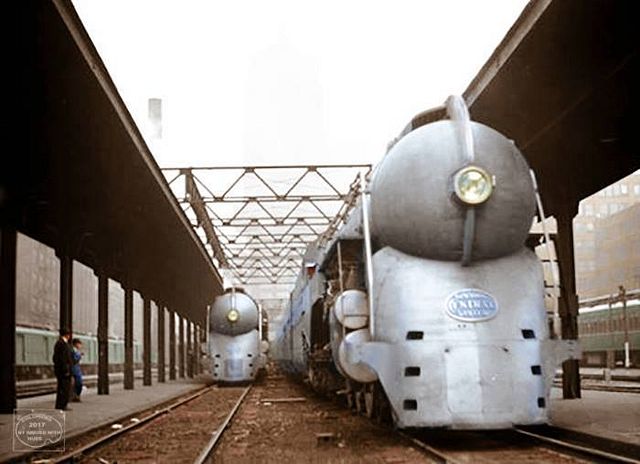
Likewise, later WW2 era black and white photos usually show these so grubby that the base coat (and yes highly oxidized) tint is largely moot anyway. Practically speaking I usually decline to weather as that’s an unneeded complication to the work order. My customers know how to do weathering whether they want to or not and I’m up front about it, so when I’m done it’s their model to do as they please.

Following up afterward my customer passed the J3A over to his digital control guy and had him install a Sunami card and the associated lighting, speaker etc. Afterward I was delighted to get these images as it allows me to forget these tribulations with the tint. I will post on this again once my customers PS set arrives, Sunset (now 3rd & Townsend?) offered the set in both the original 1938 scheme with the blue pin-striping and (his choice) the later post-1940 scheme sans blue stripes. I'm sure the factory will get these colors right...right?..

Here an absurdly close-up of the back head detail with the newly installed cab lighting, crude dial faces, sins and all.
Regarding the grey shroud color specifically this J3a version (WW2 era.) Having belabored this with Sarge, likely to his annoyance, I concluded per his advice and my own customer’s preferences that the shade of grey here (Tru-Color Pacemaker Grey) proved to be the best choice as follows- Most color shots of these engines (Ed Nowak’s for instance) are pre-war, and since this is a war time scheme per its PT tender and trimmed shrouding I discovered the handful of color shots of these engines from that period appear darker grey or "blue-ish"when they’re taken in clear-blue-sky sun-light and while the color shift or print-fail of the film image may exaggerate that, I noticed it doesn’t occur if the photo was taken with a cloud overcast as per this famous image by John W. Barriger III at LaSalle St. in Chicago, likely shot with the finest color film available to the RFC or ODT depending on the date. Likewise, the real time base coat tint on our model here appears varied depending on the light source and coverage which is the nature of off-white to light grey too.
Likewise, later WW2 era black and white photos usually show these so grubby that the base coat (and yes highly oxidized) tint is largely moot anyway. Practically speaking I usually decline to weather as that’s an unneeded complication to the work order. My customers know how to do weathering whether they want to or not and I’m up front about it, so when I’m done it’s their model to do as they please.
Following up afterward my customer passed the J3A over to his digital control guy and had him install a Sunami card and the associated lighting, speaker etc. Afterward I was delighted to get these images as it allows me to forget these tribulations with the tint. I will post on this again once my customers PS set arrives, Sunset (now 3rd & Townsend?) offered the set in both the original 1938 scheme with the blue pin-striping and (his choice) the later post-1940 scheme sans blue stripes. I'm sure the factory will get these colors right...right?..
Here an absurdly close-up of the back head detail with the newly installed cab lighting, crude dial faces, sins and all.
Last edited by De Bruin on Mon Oct 13, 2025 11:07 am, edited 2 times in total.
Political Consultant- Tap into the hidden powers of your public office, insure your future is jail free, well funded. Visit shock and awe upon your adversaries, dominate the media, thrill your followers. contact morbo@happydaysrhereagain.com
Re: Well this was different, Dreyfuss J3a
Love the back head details. They may look crude because they're blown up to "G" scale proportions at least. Looking at them in person they would look much better. Nice Job Sir!!!!!!!!!!!!!!!!!!!!!!!!!!!!!!!!!!!!!!!
Return to “O-Gauge, 2-Rail, Model Railroading”
Who is online
Users browsing this forum: No registered users and 48 guests